
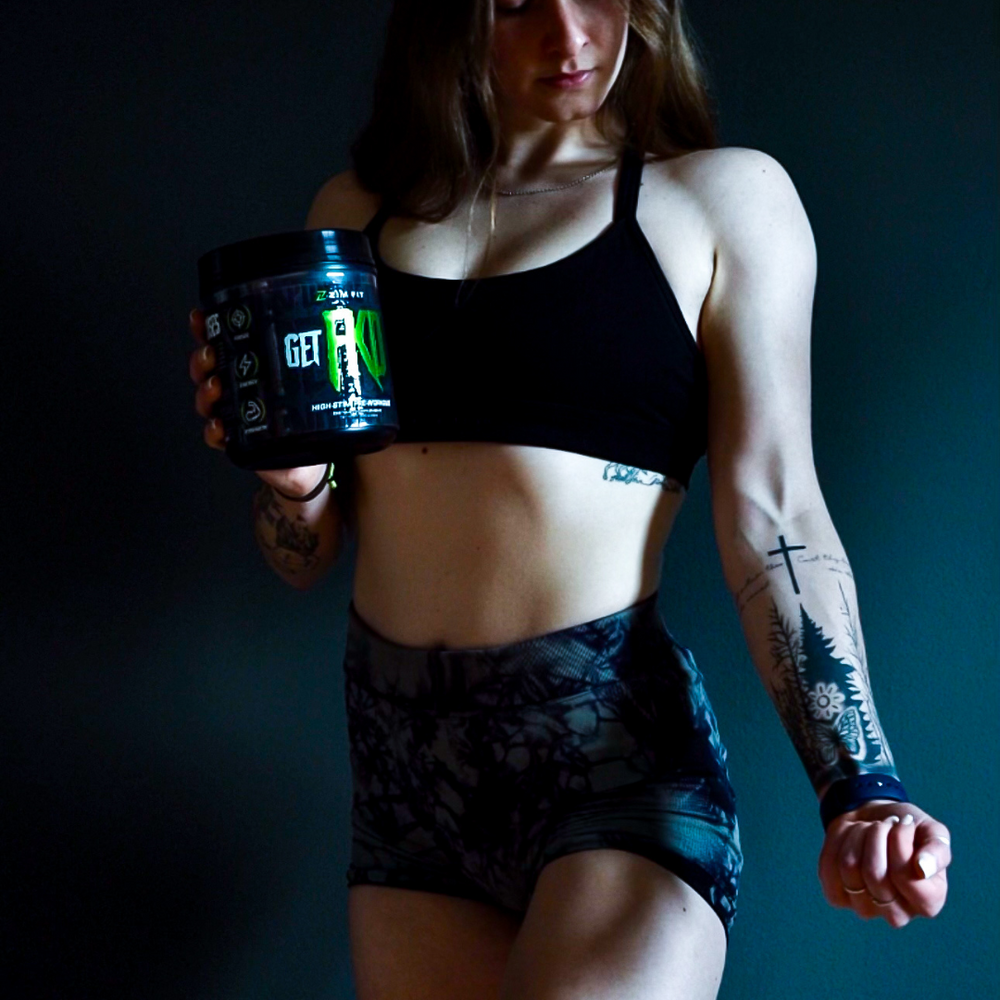
ZIM FIT Delivers More Than Caffeine: Why Vitamin B12 Belongs in Your Pre-Workout
Vitamin B12 Why It's in Every Scoop of GET FKD & GET PMPD
What B12 does for your body, why deficiency is more common than you think, where to find it, and why ZIM FIT builds it into both pre-workout formulas.
When most people think about what's in their pre-workout, they think caffeine, pump ingredients, and maybe a nootropic or two. Almost nobody thinks about Vitamin B12, and that's exactly the problem.
B12 is one of the most essential vitamins in the human body, and it's also one of the most commonly deficient. That is not because people eat poorly, but because of something far more fundamental: your body cannot produce Vitamin B12 on its own. Every microgram has to come from food, supplementation, or it simply doesn't exist in your system.
That's exactly why ZIM FIT includes 120mcg of Vitamin B12 in both GET FKD and GET PMPD. Every scoop, every time. This is the complete breakdown of what B12 does, why so many people are running low without knowing it, where else to get it, and what happens when your levels fall short.
What Is Vitamin B12?
Vitamin B12, also known as cobalamin, is a water-soluble vitamin essential to two of the most fundamental processes in the human body: red blood cell formation and neurological function. Every cell in your body depends on B12 to some degree, but it plays an especially critical role in your nervous system, your brain, and your energy metabolism.
B12 is unique among vitamins for one major reason: it is the only vitamin that contains a trace mineral — cobalt — at its core, which is where the name "cobalamin" comes from. It's also produced exclusively by bacteria and archaea in nature, not by plants or animals directly. Animals accumulate B12 in their tissues by consuming these bacteria (directly or through the food chain), which is why B12 is found almost exclusively in animal-based foods.
The most important fact about B12: the human body has no ability to synthesize it. Unlike Vitamin D, which your skin can produce from sunlight, or certain other nutrients your body can manufacture internally, B12 must come from an external source — every single time. There is no biological backup plan.
Why So Many People Are Running Low
B12 deficiency is far more common than most people realize, and it often develops silently over months or years before symptoms become noticeable. Here's why it happens so frequently.
Your Body Can't Make It
Since B12 isn't synthesized internally, any disruption to intake or absorption — even a small one — can cause levels to decline over time. There's no internal production to fall back on if dietary intake slips.
Plant-Based Diets
B12 is found almost exclusively in animal products — meat, dairy, eggs, and fish. Vegetarians, and especially vegans, are at significantly higher risk of deficiency unless they're deliberately supplementing or eating fortified foods.
Absorption Requires a Complex Process
Unlike most nutrients, B12 absorption requires a protein called intrinsic factor, produced in the stomach, to bind to it before it can be absorbed in the small intestine. Anything that disrupts stomach acid production or intrinsic factor — age, certain medications, or digestive conditions — can block absorption even when intake is adequate.
Aging Reduces Absorption
As we age, stomach acid production naturally declines — and stomach acid is required to release B12 from the proteins in food. Studies show a significant percentage of adults over 50 have reduced B12 absorption, even with adequate dietary intake.
Common Medications Interfere
Long-term use of proton pump inhibitors (PPIs), certain acid reflux medications, and Metformin (commonly prescribed for type 2 diabetes) have all been shown in research to reduce B12 absorption over time — often without the user realizing it.
High-Demand Lifestyles
Athletes and highly active individuals have elevated metabolic and red blood cell turnover demands. Heavy training increases the body's need for B12 to support oxygen transport and energy metabolism — meaning the same intake that was once sufficient may no longer keep pace.
according to population health research — with rates significantly higher in at-risk groups
What B12 Does for Your Body
B12's role in the body extends far beyond a single function, it's involved in some of the most fundamental processes that determine how you feel, think, and perform on a daily basis.
Red Blood Cell Formation
B12 is essential for the production of healthy, properly formed red blood cells. Without adequate B12, the body produces red blood cells that are abnormally large and fragile — a condition called megaloblastic anemia — which impairs their ability to carry oxygen efficiently throughout the body.
Energy Metabolism
B12 plays a direct role in converting the food you eat into usable cellular energy by supporting key metabolic reactions involved in fatty acid and amino acid metabolism. This is precisely why B12 deficiency is so closely linked to fatigue, even when sleep and caloric intake are adequate.
Nervous System Function
B12 is critical for maintaining the myelin sheath — the protective coating around nerve fibers that allows for fast, efficient transmission of nerve signals. Adequate B12 supports healthy cognitive function, reaction time, and coordination — all relevant to athletic performance.
DNA Synthesis
B12 is required for the synthesis of DNA in every dividing cell in the body. This makes it essential for tissue repair and regeneration — including the muscle tissue repair that occurs after intense training.
Homocysteine Regulation
B12, alongside folate and B6, helps regulate homocysteine levels in the blood. Elevated homocysteine is associated with increased cardiovascular risk, making adequate B12 intake a meaningful factor in long-term heart health.
Mood & Cognitive Support
B12 is involved in the synthesis of neurotransmitters including serotonin and dopamine. Research has linked low B12 status with increased risk of depressive symptoms, brain fog, and impaired concentration — all of which directly affect training consistency and motivation.
"You can't out-train a B12 deficiency. Low energy, poor recovery, and brain fog often trace back to a vitamin most people never think to check."
— ZIM FIT USA, Education SeriesWhat Happens If You Don't Get Enough
Because B12 deficiency develops gradually, sometimes over years, as your body's stored reserves slowly deplete, the symptoms often creep in subtly. Many people attribute the early signs to stress, poor sleep, or simply "getting older," without realizing a nutrient deficiency is the underlying cause.
If several of the symptoms below sound familiar and persist over time, it may be worth discussing B12 levels with a healthcare provider — a simple blood test can confirm your status.
- Persistent fatigue and weakness. One of the earliest and most common signs, a tired, sluggish feeling that doesn't improve with rest, often linked to impaired oxygen transport from reduced red blood cell function.
- Brain fog and difficulty concentrating. Because B12 directly supports nervous system and neurotransmitter function, low levels are commonly associated with mental cloudiness, poor focus, and slower processing.
- Numbness or tingling in the hands and feet. A hallmark neurological symptom, long-term deficiency can damage the myelin sheath protecting nerves, leading to sensations of pins and needles, particularly in the extremities.
- Mood changes, including irritability or low mood. Given B12's role in neurotransmitter synthesis, deficiency has been associated with increased risk of depressive symptoms and general mood disturbance.
- Pale or yellowish skin. A visible sign of megaloblastic anemia, when red blood cells are malformed and break down more quickly than normal, releasing bilirubin and creating a pale or jaundiced appearance.
- Shortness of breath and dizziness, especially during exertion. Reduced oxygen-carrying capacity from impaired red blood cell formation makes physical exertion — including training — feel disproportionately difficult.
- Heart palpitations. The body may compensate for reduced oxygen delivery by increasing heart rate, which can be felt as a racing or irregular heartbeat.
- Memory problems. Chronic, severe deficiency has been linked in research to cognitive decline and memory impairment, particularly in older adults.
- Glossitis and mouth ulcers. A swollen, inflamed tongue and recurring mouth sores are a lesser-known but well-documented symptom of B12 deficiency.
- Decreased athletic performance and slower recovery. For active individuals specifically, suboptimal B12 status can mean reduced endurance, slower recovery between sessions, and a general sense that your training output doesn't match your effort.
The danger of slow onset: Because the liver stores several years' worth of B12 in reserve, deficiency symptoms often don't appear until those reserves are significantly depleted — meaning by the time symptoms show up, the deficiency may have been developing for a long time. This is exactly why consistent intake matters more than occasional correction.
Where to Find B12 in Real Food
Because B12 is produced by bacteria and concentrated through the animal food chain, it's found almost exclusively in animal-based foods. Here's how common sources stack up.
The plant-based gap: With the exception of fortified foods like nutritional yeast, fortified cereals, and fortified plant milks, B12 does not naturally occur in any plant food. Vegetarians can typically meet their needs through eggs and dairy, but vegans are at the highest risk and should strongly consider consistent supplementation — fortified foods alone can be inconsistent in dose and bioavailability.
Recommended Daily Intake
| Population | Recommended Daily Intake |
|---|---|
| Adults (19+) | 2.4mcg |
| Pregnant Individuals | 2.6mcg |
| Breastfeeding Individuals | 2.8mcg |
| Active Individuals / Athletes | Often benefit from higher intake due to increased metabolic and red blood cell turnover demands |
| Adults Over 50 | Same baseline, but absorption efficiency often declines — supplementation or fortified foods are commonly recommended |
Vitamin B12 in GET FKD & GET PMPD
Most pre-workout brands focus exclusively on stimulants and pump ingredients, leaving foundational nutrients like B12 out of the formula entirely. ZIM FIT takes a different approach — because a pre-workout shouldn't just give you a temporary boost, it should support the systems your body actually relies on to perform and recover.
That's why both GET FKD and GET PMPD include 120mcg of Vitamin B12 per scoop — a meaningful, well-above-baseline dose included in every single serving, regardless of which formula you choose.
Every scoop of GET FKD delivers a full B12 dose alongside the high-stim energy stack — supporting the energy metabolism and oxygen transport your body needs during intense, high-output training sessions.
Shop GET FKDGET PMPD includes the same 120mcg B12 dose, supporting consistent energy metabolism and red blood cell health — regardless of when you train or how sensitive you are to stimulants.
Shop GET PMPDWhy a high dose makes sense in pre-workout: B12 is water-soluble, meaning your body excretes what it doesn't use rather than storing excess to toxic levels — there is no established upper limit for B12 due to its strong safety profile. A higher dose ensures meaningful absorption even accounting for natural variability in individual absorption efficiency, particularly relevant for active individuals with elevated metabolic demands.
B12 and Athletic Performance
For anyone training seriously, B12's role goes beyond general health — it directly intersects with the systems that determine how you perform and recover.
- Oxygen delivery to working muscles. Healthy red blood cell production, supported by adequate B12, ensures efficient oxygen transport to muscle tissue during training — directly impacting endurance and output.
- Energy metabolism under load. B12's role in converting food into usable energy becomes increasingly important as training volume and intensity increase, supporting the metabolic demands of consistent, hard training.
- Recovery and tissue repair. B12's involvement in DNA synthesis supports the cellular repair processes that occur after intense training — when muscle tissue is actively rebuilding and adapting.
- Mental sharpness during training. B12's neurological support contributes to focus, coordination, and reaction time — all relevant whether you're working through a complex lift or pushing through the final reps of a set.
- Consistency over time. Because B12 has no natural backup production in the body, consistent intake — like getting it in every scoop of your pre-workout — helps prevent the gradual depletion that leads to fatigue and underperformance months down the line.
If you eat a varied, omnivorous diet, the 120mcg of B12 in your daily GET FKD or GET PMPD scoop provides a strong baseline alongside dietary sources. If you're vegetarian, vegan, over 50, or on medications known to interfere with B12 absorption (like Metformin or long-term PPIs), the B12 in your ZIM FIT pre-workout becomes an even more meaningful part of covering your daily needs — though discussing your specific levels with a healthcare provider is always the right move if you suspect a deficiency.
The Bottom Line on B12
Vitamin B12 is one of the most essential — and most overlooked — nutrients for anyone who trains seriously. Here's what to remember:
- Your body cannot produce B12 on its own. Every microgram must come from food, fortified products, or supplementation — there is no internal backup.
- B12 supports red blood cell formation, energy metabolism, nervous system function, DNA synthesis, cardiovascular health, and mood regulation.
- Deficiency is more common than most people realize, driven by plant-based diets, aging, certain medications, and the absorption complexity unique to this vitamin.
- Symptoms of deficiency often develop slowly and are easy to misattribute — fatigue, brain fog, numbness, mood changes, and reduced athletic performance are all common signs.
- B12 is found almost exclusively in animal products — meat, fish, eggs, and dairy — with fortified foods as the primary option for those eating plant-based.
- Both GET FKD and GET PMPD include 120mcg of Vitamin B12 per scoop — the same meaningful dose in every formula, every time.
- B12 is water-soluble with an excellent safety profile and no established upper intake limit, making a higher dose in pre-workout a smart, low-risk way to support consistent intake.
More Than Energy. Real Support.
GET FKD and GET PMPD deliver 120mcg of Vitamin B12 in every scoop — because performance starts with the fundamentals. Zero corners cut. Zero FK'N Excuses.
Shop GET FKD Shop GET PMPD


Leave a comment