
What Is Non-Stim Pre-Workout? Low-Stim vs. Stim-Free
Less Stim
What Is Non-Stim Pre-Workout?
Non-stim pre-workout is a training supplement made without caffeine or other stimulants. Low-stim pre-workout still contains stimulants, usually in a smaller amount, so the two are not the same. GET PMPD is low-stim, with 85 mg of caffeine per serving, not stim-free. Check the Supplement Facts to see which one you are buying.
That difference decides who a formula fits. If you train late, already drink coffee, or simply want less caffeine than your usual tub, a lower-stimulant option can make sense. If you've been told to avoid caffeine or stimulants entirely, you need a formula with none, and GET PMPD isn't it.
The label has to be checked for both things. A caffeine-free claim on the front of a tub covers caffeine only. The ingredient list tells you whether anything else in the scoop is a stimulant.
Low-Stim vs. Stim-Free Pre-Workout
Non-stim, non-stimulant, and stim-free describe the same category: a stimulant free pre-workout, made with no caffeine and no other stimulants. Low-stim is a different category. It still contains stimulants, positioned at a lower amount than a high-stim formula, and there's no official cutoff for what counts as low.
So don't choose by the front of the tub alone. Check the Supplement Facts, the ingredient list, and the amount per serving.
| Category | What It Means | What to Check |
|---|---|---|
| Stim-free / Non-stim | No caffeine or other stimulants. | The full ingredient list, not just the caffeine claim. |
| Low-stim | Still contains stimulants, with a lower-stimulant positioning. | The actual stimulant ingredients and amounts per serving. |
| High-stim | Positioned around a higher stimulant intake. | Total caffeine, other stimulants, directions, and warnings. |
What Does Non-Stim Pre-Workout Do?
A non-stim pre-workout aims to support training through ingredients other than stimulants. Depending on the formula, the focus might be pump-related pathways, high-intensity exercise support, or fluid balance. Those are different jobs, and a longer ingredient list doesn't automatically do them better.
These are ingredients you'll commonly see on stim-free and low-stim labels. Each does a different job, and the form and amount on the label matter as much as the name.
- Citrulline: involved in the body's nitric oxide pathway; check whether the label lists L-citrulline or citrulline malate, because they aren't equal gram for gram.
- Beta-alanine: raises muscle carnosine, which buffers acid during hard efforts, and is the usual source of tingling without being a stimulant.
- Betaine: a compound found in foods like beets and spinach, with limited and mixed exercise research.
- Taurine: an amino acid common in pre-workouts and energy drinks, and not a stimulant.
- Creatine: usually studied as a daily supplement that builds up in muscle over time, which is why GET PMPD leaves it out.
Ingredient research has limits. The NIH review of exercise supplements describes limited and conflicting performance evidence for citrulline and mixed findings for beta-alanine. Research on an individual ingredient is not a clinical trial of every pre-workout that contains it, so judge each one by its form, its amount, and the evidence behind it.
For a closer look at individual ingredients and doses, use our supplement ingredient guide.
Pre-Workout Without Caffeine for Evening Training
If avoiding caffeine is the priority, choose a genuinely caffeine-free formula and check for other stimulants too. If you want some caffeine, just less than your usual pre-workout, a low-stim option serves a different purpose.
Lower caffeine does not guarantee uninterrupted sleep. In a small placebo-controlled study of 12 adults, 400 mg of caffeine disrupted objectively measured sleep even when taken six hours before bed. That study did not test GET PMPD or an 85 mg dose, so it cannot establish a universal cutoff for either.
Run one practical check before an evening session: coffee, energy drinks, and pre-workout all count toward the same daily caffeine total. For most adults, the FDA has cited 400 mg a day as an amount not generally associated with negative effects, and it notes wide variation in how sensitive people are and how fast they clear caffeine. Add up what you've already had before you scoop.
Consider your bedtime and your own response to caffeine as well. Don't assume finishing your workout means the caffeine has left your system. Timing and tolerance basics are covered in how to take pre-workout.
For trainers recommending a product to clients, make this distinction explicit: lower caffeine may fit someone who wants less. It does not meet a requirement to avoid stimulants.
Where GET PMPD Fits
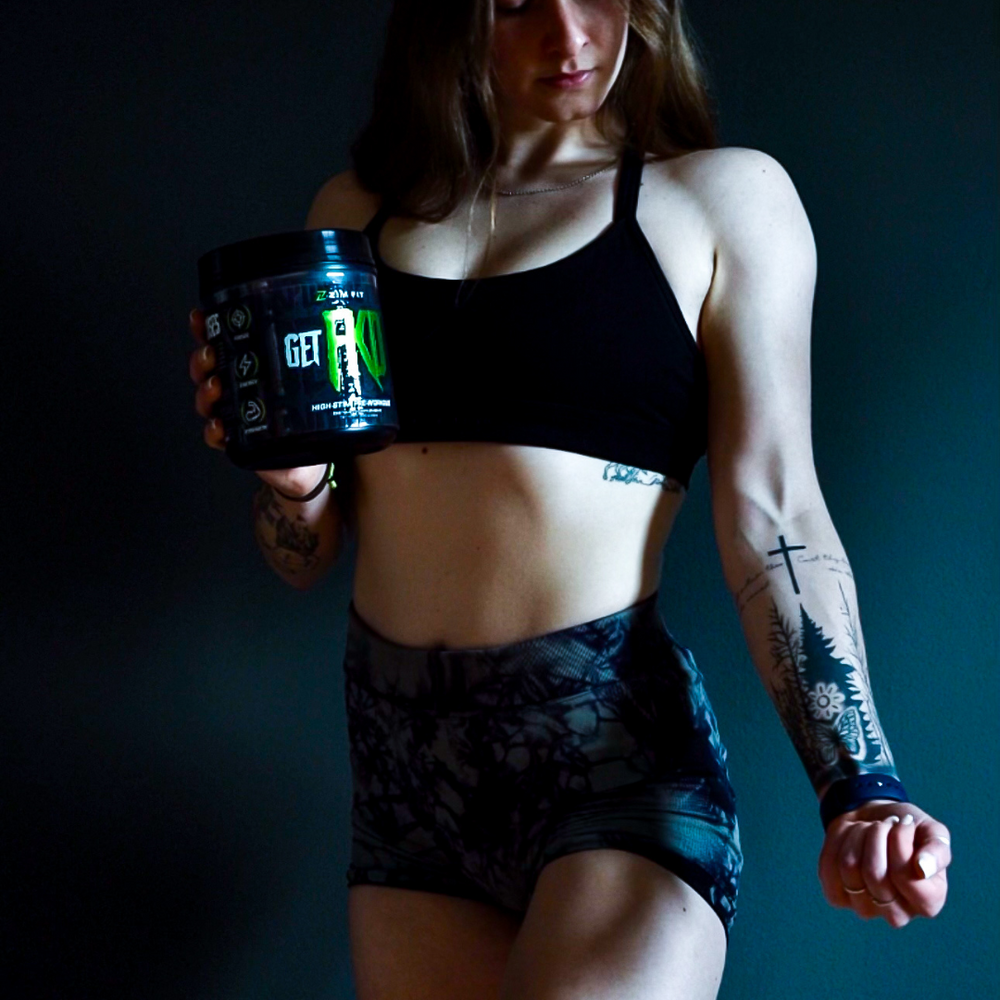
If GET FKD high stimulant pre-workout is already your option for heavy days, you don't need to treat every session as the same caffeine decision. GET PMPD low-stim pre-workout is a different formula with 85 mg of caffeine per serving, for the sessions when you want less stimulant intake.
The caffeine number is only one part of that formula. GET PMPD also lists 7 g of L-citrulline, 3 g of GlycerPump™ 65% glycerol powder, and 3.2 g of beta-alanine per serving. The 3 g GlycerPump figure is the weight of the powder preparation, not 3 g of pure glycerol.

Low stim should not mean low performance. The way to check that is to read the rest of the panel instead of assuming caffeine strength measures the whole formula. These amounts describe what's in GET PMPD; they aren't a promise of a particular result.
Choose this if:
- Low-stim, like GET PMPD: you want less caffeine, not zero.
- A caffeine-free formula: you need no caffeine or other stimulants at all. GET PMPD doesn't meet that requirement.
If you want both kinds of day covered, the GET FKD + GET PMPD stack puts one tub of each in a single order. A second tub means an alternative for different sessions, not a recommendation to combine servings. Start with half a scoop to assess tolerance, and follow the directions and warnings on your tub. If you've been advised to avoid caffeine or stimulants, don't substitute a low-stim product for a stim-free one.
Choose the Stimulant Level That Fits the Session
Start with the requirement, then read the label against it.
- Do you need no stimulants? Choose a stim-free formula and check the full ingredient list, not just the caffeine claim.
- Do you want less caffeine? A low-stim formula fits. If GET FKD is your usual tub, GET PMPD is the lower-caffeine option for other sessions.
- Do you want your usual higher-stim option? Keep it, and count its total caffeine against everything else you've had that day.
Don't use the intensity of the tingles or the word “clean” as a substitute for the serving, the ingredient amounts, and the warnings. Neither choice replaces food, hydration, sleep, or the work itself.
To put any tub side by side, including one you already own, compare your pre-workout with our label tool. For when each stimulant level fits a training week, read the high stim vs low stim guide.
Frequently Asked Questions
What Is a Non-Stimulant Pre-Workout?
A non-stimulant pre-workout, also called a stimulant-free or stim-free pre-workout, is made without caffeine or other stimulants. It may contain non-stimulant ingredients intended for different aspects of training, but formulas vary. Check the full panel rather than assuming every caffeine-free product has the same ingredients or benefits.
Is Low-Stim the Same as Stim-Free?
No. Low-stim products still contain stimulants; stim-free products do not. GET PMPD is a low-stim pre-workout with 85 mg of caffeine per serving. It should not be described or selected as a stimulant-free option.
Is GET PMPD a Pre-Workout Without Caffeine?
No. GET PMPD contains 85 mg of caffeine per serving. It is an option for someone seeking lower caffeine, not zero caffeine. If avoiding caffeine is a requirement, choose a product that meets that requirement instead.
Can Non-Stim Pre-Workout Still Make You Tingle?
Yes, if it contains beta-alanine. Beta-alanine can cause a tingling sensation without caffeine being present. Tingling does not tell you the stimulant level, prove that a product is effective, or measure the quality of the formula.
Can I Take Low-Stim Pre-Workout Before Bed?
Low-stim does not mean sleep-neutral. Timing, dose, other caffeine sources, and individual response matter. There is no universal promise that a lower-caffeine pre-workout will leave sleep unaffected. Follow the label, and choose a stimulant-free option when avoiding stimulants is the priority.
Does Non-Stim Pre Still Give You Energy?
Not the way caffeine does. A non-stim formula has no caffeine, so it won't give you a caffeine-style lift; its ingredients target other parts of training. If you want some lift with less caffeine than a high-stim tub, GET PMPD's 85 mg per serving is the option for that.
Is Non-Stim Pre-Workout Any Good?
That depends on the formula. Results depend on which ingredients are in it and in what amounts, and the NIH review of exercise supplements describes mixed evidence for individual ingredients such as citrulline and beta-alanine. Read the amounts per serving before you judge any tub, stim-free or not.
Does Non-Stim Pre-Workout Have Caffeine?
No. Non-stim formulas are made without caffeine. Check the label for other stimulants too, because a caffeine-free claim covers caffeine only.
Will a Non-Stim Pre-Workout Keep Me Awake?
A stim-free formula contains no caffeine by definition, but no label can promise how a product will affect your sleep. Check the full ingredient list for other stimulants, and remember that coffee or energy drinks earlier in the day still count.
How Much Caffeine Is in a Low-Stim Pre-Workout?
There's no official cutoff for low-stim, so the amount varies by product. Check the caffeine per serving on the Supplement Facts, including any second caffeine source. GET PMPD lists 85 mg of caffeine per serving.
Sources
- NIH Office of Dietary Supplements: Dietary Supplements for Exercise and Athletic Performance
- Drake et al., Caffeine Effects on Sleep Taken 0, 3, or 6 Hours before Going to Bed, Journal of Clinical Sleep Medicine (2013)
- U.S. Food and Drug Administration: Spilling the Beans: How Much Caffeine Is Too Much?
UPDATED Nov 8, 2026


Leave a comment