
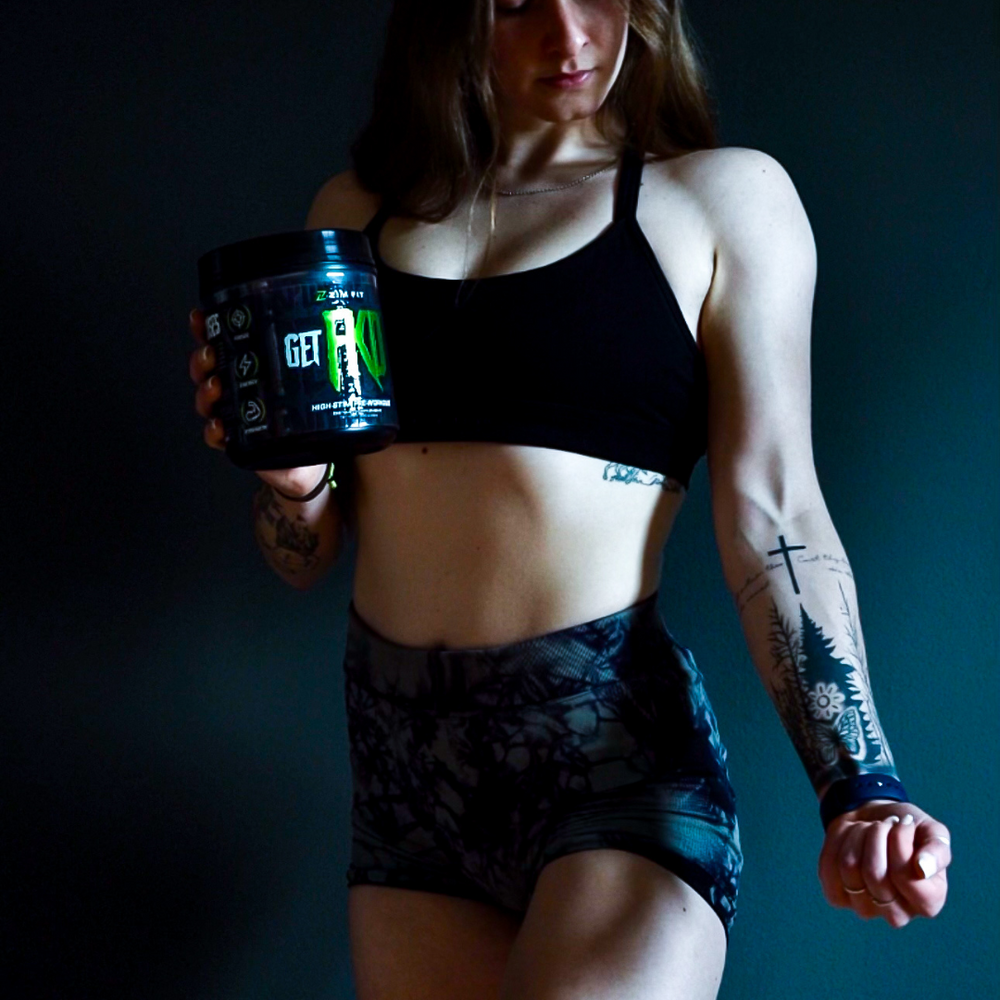
ZIM FIT Delivers More Than Caffeine: Why Vitamin B12 Belongs in Your Pre-Workout
Vitamin B12: Why It's in Every Scoop of GET FKD and GET PMPD
What vitamin B12 does, who tends to run low, where to get it from food, and why both of our pre-workouts carry 120mcg per scoop. Straight facts, including what B12 won't do.
01 — The Basics
What Is Vitamin B12?
Vitamin B12, also called cobalamin, is a water-soluble vitamin your body needs to make healthy red blood cells, keep your nervous system working, and build DNA. It's the only vitamin with a mineral at its core (cobalt, which is where the name comes from), and your body can't make it. Every bit you have comes from food, fortified products, or supplements.
B12 is made by bacteria and works its way up the food chain, which is why it shows up naturally in animal foods like meat, fish, eggs, and dairy, and not in plants. The upside: your liver stores a lot of it. Your body holds roughly 1 to 5 milligrams, more than a thousand times what you'd eat in a day, according to the NIH Office of Dietary Supplements. That's also why low B12 can take years to show up.
If your B12 levels are already fine, more B12 won't hit like an energy boost. It's not a stimulant. In a pre-workout, the caffeine does that job. B12 is there to support the systems you rely on every day, especially if your diet or health puts you at risk of running low.
02 — Who Runs Low
Who Is Most Likely to Be Low on B12
Most people in the U.S. get enough B12 from food. Still, NIH data estimates about 3.6% of adults are deficient and around 12.5% have levels on the low side, and some groups are at higher risk:
- Vegetarians and vegans. B12 doesn't occur naturally in plant foods, so plant-based eaters need fortified foods or supplements.
- Adults over 50. Stomach acid tends to drop with age, and you need it to free B12 from food. Free B12 in supplements and fortified foods skips that step.
- People on certain medications. Long-term use of metformin or acid-reducing drugs like proton pump inhibitors can lower B12 absorption.
- People with digestive conditions or GI surgery. Absorbing B12 depends on a protein from the stomach called intrinsic factor, and anything that disrupts it can cause problems even when intake is fine.
03 — What It Does
What Vitamin B12 Does for Your Body
- Red blood cell formation. Without enough B12, your body makes large, fragile red blood cells that carry oxygen poorly, a condition called megaloblastic anemia.
- Nervous system health. B12 helps maintain myelin, the coating around nerves that keeps signals moving.
- Energy metabolism. B12 helps your cells use fats and amino acids for energy. That's why being low on B12 is linked to fatigue.
- DNA synthesis. Every dividing cell in your body needs B12 to copy its DNA.
- Homocysteine control. Along with folate and B6, B12 helps convert homocysteine into methionine. Both of our formulas also carry 8.5mg of vitamin B6.
04 — Warning Signs
Signs of Low Vitamin B12
Because your liver keeps a large reserve, low B12 tends to build slowly, and the early signs are easy to blame on stress or bad sleep. Common signs include:
- Fatigue and weakness that doesn't improve with rest
- Numbness or tingling in the hands and feet
- Pale skin, shortness of breath, or a racing heartbeat with effort
- A sore, swollen tongue
- Trouble concentrating, memory problems, or low mood
These signs have plenty of other causes. If several sound familiar and stick around, ask your doctor for a blood test. A pre-workout isn't a treatment for a deficiency, and nerve-related symptoms in particular need medical attention early.
05 — Food Sources
Best Food Sources of Vitamin B12
The adult daily recommendation is 2.4mcg, rising to 2.6mcg during pregnancy and 2.8mcg while breastfeeding. Here's how common foods stack up, based on the NIH fact sheet:
| Food | Serving | B12 |
|---|---|---|
| Beef liver, cooked | 3 oz | 70.7mcg |
| Clams, cooked | 3 oz | 17mcg |
| Oysters, cooked | 3 oz | 14.9mcg |
| Nutritional yeast, fortified | About ¼ cup | 8.3–24mcg (check the label) |
| Salmon, Atlantic, cooked | 3 oz | 2.6mcg |
| Tuna, light, canned | 3 oz | 2.5mcg |
| Ground beef, 85% lean | 3 oz | 2.4mcg |
| Milk, 2% | 1 cup | 1.3mcg |
| Yogurt, plain, fat free | 6 oz | 1.0mcg |
| Egg, whole, cooked | 1 large | 0.5mcg |
| Cheddar cheese | 1.5 oz | 0.5mcg |
If you eat meat, fish, eggs, or dairy most days, you're likely covered by food alone. If you eat plant-based, fortified foods or a supplement are how you get it.
06 — Inside the Scoop
Vitamin B12 in GET FKD and GET PMPD
Both GET FKD® High-Stim Pre-Workout and GET PMPD® Low-Stim Pre-Workout carry 120mcg of vitamin B12 as methylcobalamin in every scoop, alongside 8.5mg of vitamin B6. It's printed on the label like every other dose.
Why 120mcg when the daily recommendation is 2.4mcg? Absorption. Your body absorbs about half of a small dose, but once you go past 1 to 2mcg at a time, the share it takes in drops sharply. That's why B12 supplements commonly run from 50 to well over 500mcg. And the Food and Nutrition Board hasn't set an upper limit for B12, because it has a very low potential for toxicity.
B12 isn't the reason to pick one formula over the other. Caffeine is. GET FKD carries about 350mg for the days you want everything turned up, and GET PMPD carries 85mg for evening sessions or a lower stim load. Our high-stim vs. low-stim guide helps you choose.
Frequently Asked Questions
Does vitamin B12 give you energy?
Only if you're low on it. B12 helps your body turn food into energy and make healthy red blood cells, so being low on it can cause fatigue. If your levels are already normal, extra B12 won't feel like a boost. In a pre-workout, the caffeine handles that.
How much vitamin B12 is in GET FKD and GET PMPD?
120mcg per scoop in both, as methylcobalamin. That's 5,000% of the Daily Value. Both formulas also carry 8.5mg of vitamin B6.
Is 120mcg of B12 too much?
No upper limit has been set for B12 because it has a very low potential for toxicity, and at higher doses your body absorbs only a small share. If you take medication or have a medical condition, check with your doctor before adding any supplement.
Who should pay the most attention to B12?
Vegetarians and vegans, adults over 50, and people taking metformin or acid-reducing medications long term. If that's you, ask your doctor about testing your levels.


Leave a comment