
L-Citrulline vs. Citrulline Malate: Read the Form, Then the Dose
L-Citrulline vs. Citrulline Malate: Read the Form, Then the Dose
L-citrulline and citrulline malate don't deliver the same amount of citrulline gram for gram. Here's the label math, what the research shows, and how to compare your own tub.
Six Grams Can Mean Two Different Things
Pure L-citrulline lists the amino acid itself. Citrulline malate combines L-citrulline with malate, so the total ingredient weight includes both components. That's the difference to check before comparing the numbers on two labels.
6g of pure L-citrulline provides 6g of L-citrulline. A 6g citrulline-malate blend at a stated 2:1 ratio by weight provides approximately 4g of L-citrulline and 2g of malate. If the ratio isn't disclosed, you can't calculate the citrulline amount from the blend weight alone.
Malate is involved in energy metabolism. That doesn't make it an inactive filler, and it doesn't establish that citrulline malate is better or worse for your training. Ingredient composition and performance evidence are separate questions.
The useful comparison starts with the form, the stated ratio, and the amount per serving. Use that same check on our label and any other tub you're considering.
How Much L-Citrulline Is in Citrulline Malate?
For a stated ratio by weight, divide the citrulline part by the total number of parts, then multiply by the ingredient weight. For 2:1, that's 2 divided by 3.
| Listed Ingredient | Listed Weight | Calculated L-Citrulline |
|---|---|---|
| Pure L-citrulline | 6g | 6g |
| Citrulline malate, stated 2:1 | 6g | Approximately 4g |
| Citrulline malate, stated 1:1 | 6g | Approximately 3g |
| Citrulline malate, stated 2:1 | 8g | Approximately 5.3g |
| Citrulline malate, ratio unspecified | 6g | Cannot be calculated from weight alone |
A ratio tells you the intended composition, not independently verified purity. If a proprietary blend lists several ingredients under one combined weight, that blend total also won't tell you the individual citrulline dose.
L-Arginine vs. L-Citrulline in Pre-Workout
L-citrulline is a non-essential amino acid found naturally in watermelon and produced by your body. Your kidneys convert it into L-arginine, which is a substrate for nitric oxide production. Nitric oxide helps blood vessels relax and widen.
Oral arginine undergoes substantial breakdown in the gut and liver before reaching the circulation. Citrulline largely avoids that first-pass breakdown and can raise circulating arginine more efficiently. The 2018 review of citrulline metabolism and vascular function explains that distinction.
That pathway explains why L-citrulline appears in pre-workout formulas. It doesn't mean every milligram becomes nitric oxide, or that a bigger pump proves a formula improves strength or muscle growth.
What Citrulline Research Actually Supports
The evidence includes positive findings and trials with no measurable benefit. Read the ingredient form, dose, participants, and outcome before applying a study to your training.
Repetitions
A 2021 meta-analysis of eight studies found a small average improvement in repetitions to failure with 6g to 8g of citrulline malate taken 40 to 60 minutes before exercise. Those are blend weights, not pure-L-citrulline doses, and the average isn't a promise for an individual workout.
Effort and Soreness
A 2020 meta-analysis found lower post-exercise perceived exertion and less soreness at 24 hours, with substantial variation between studies. It did not find a significant reduction in blood lactate.
Pure L-citrulline results aren't uniformly positive either. In a 2023 randomized crossover trial in 18 resistance-trained men and women, a single 8g dose one hour before testing did not improve the measured strength, muscle-endurance, or muscle-oxygenation outcomes.
These studies examine ingredient supplementation, not a clinical trial of GET FKD or GET PMPD. They support a more useful conclusion than a guaranteed result: citrulline may help some training outcomes, but the response depends on the protocol and isn't consistent across studies.
There Isn't One Universal Citrulline Cutoff
The number only makes sense alongside the form and the outcome being studied. The 2020 review discussed 3g to 4g of L-citrulline or 8g of citrulline malate approximately one hour before exercise. The 2021 repetition analysis examined 6g to 8g of citrulline malate. Neither establishes a universal 6g minimum for pure L-citrulline.
A label with 3g or 4g of L-citrulline isn't automatically a useless or "half-dosed" product. Likewise, a higher number doesn't guarantee a better workout. Check the actual citrulline amount, the evidence relevant to your goal, and the rest of the formula.
Research timing isn't a product direction. Many acute studies used approximately one hour before exercise. For your pre-workout, follow its current label directions and warnings. Don't add scoops to chase an isolated ingredient dose: caffeine and every other ingredient increase too.
Our L-Citrulline Amounts, Stated Directly
For a lower-caffeine formula with a clearly listed citrulline amount, GET PMPD low-stim pre-workout provides 7g of L-citrulline per full serving, alongside 3g of GlycerPump™ 65% glycerol powder and 85mg of caffeine. That 3g is the GlycerPump ingredient weight, not 3g of pure glycerol.
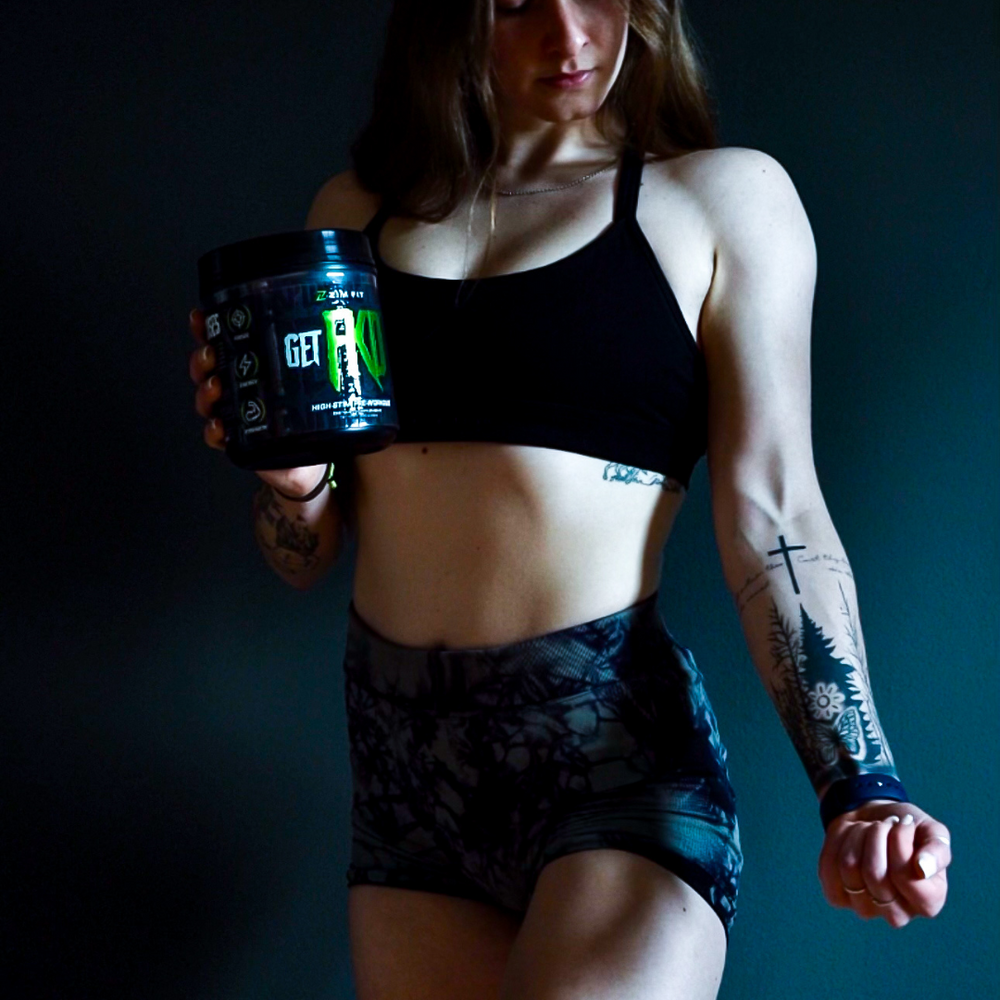
GET FKD high-stim pre-workout provides 6g of L-citrulline per full serving, plus 4g of beta-alanine, 2.5g of betaine anhydrous, and 300mg of L-theanine. Its caffeine is approximately 350mg per serving, a rounded figure rather than an exact active-caffeine sum.
| Product | L-Citrulline | Caffeine |
|---|---|---|
| GET PMPD | 7,000mg, L-citrulline | 85mg |
| GET FKD | 6,000mg, L-citrulline | Approximately 350mg |
Both list L-citrulline itself, not citrulline malate, so there's no malate ratio to subtract from those citrulline amounts. Choose the overall formula and caffeine level that fit you, not just the larger citrulline number. GET PMPD is low-stim, not stimulant-free, and lower caffeine doesn't guarantee it won't affect your sleep.
Ingredient form is one part of reading a formula. For another ingredient topic, see our AstraGin® explainer.
The practical takeaway: flip the tub over. Read the serving size, identify the citrulline form, and check the ratio if it's citrulline malate. Compare the amount of L-citrulline, not just the headline ingredient weight.
L-Citrulline and Citrulline Malate FAQ
Is L-citrulline better than citrulline malate?
Not automatically. Pure L-citrulline makes the citrulline amount straightforward to read. Citrulline malate includes malate, so you need the ratio to calculate the citrulline fraction. That composition difference alone doesn't prove superior performance. Compare the actual dose and the research relevant to the outcome you care about.
How much L-citrulline is in 6g of citrulline malate?
At a stated 2:1 ratio by weight, approximately 4g. At a stated 1:1 ratio by weight, approximately 3g. If the label doesn't disclose the ratio or separately state the L-citrulline amount, the total blend weight isn't enough to calculate it. Ask the manufacturer rather than guessing.
Is 4g of L-citrulline too little in a pre-workout?
It isn't automatically too little. Research has used different forms and doses for different outcomes, and the 2020 review discussed 3g to 4g of L-citrulline. There is no single dose that guarantees benefits for everyone. Evaluate the evidence and follow the finished product's directions instead of treating 6g as a universal cutoff.
Why use L-citrulline instead of L-arginine?
Citrulline largely avoids the gut and liver breakdown that limits the availability of oral arginine. Your kidneys then convert it into arginine, which supports nitric oxide production. That makes citrulline a useful way to raise circulating arginine, but it doesn't guarantee improved lifting performance or a particular pump.
When should I take citrulline before training?
Many acute exercise studies administered citrulline approximately 40 to 60 minutes before testing. That's a description of research protocols, not a replacement for your product's directions. Follow the current label, including serving limits and warnings, and don't increase a multi-ingredient pre-workout dose just to match a study.


Leave a comment