
Is Pre Workout Better Than Energy Drinks? What the Label Actually Tells You
Is pre workout better than energy drinks? It depends on the job. For training, usually yes: a pre-workout pairs caffeine with training ingredients like L-citrulline and beta-alanine. For a quick lift at work, a can is simpler. Either way, check the caffeine on the label, because it adds up across the day.
We make pre-workout at ZIM FIT, so we have a stake in this comparison. We'll show you our amounts, the can's amounts where they're disclosed, and the prices behind the math.
Can or Scoop
What Is the Difference Between Pre Workout and Energy Drinks?
An energy drink is a ready-to-drink caffeine option. A pre-workout is a training supplement whose formula can include caffeine plus other ingredients. The container doesn't tell you which is better. The serving and the label do.
A cold can is easy: open it and go. Powder needs water, a measured scoop and a bottle. That extra preparation buys you a choice of portion and, with a disclosed formula, a clear view of what goes into it.
| What to compare | Pre-workout powder | Energy drink |
|---|---|---|
| Main purpose | Training support, formula-dependent | Convenient caffeine and alertness |
| Preparation | Measure and mix with water | Ready to drink |
| Caffeine | Varies; stimulant-free formulas also exist | Varies by product and can size |
| Other ingredients | May include citrulline, beta-alanine and betaine | May include vitamins, taurine or training ingredients |
| Sugar and timing | Check the panel and use directions | Sugared and zero-sugar options; follow the can's directions |
The FDA describes energy drinks as generally containing 54 to 328mg caffeine per 16 fl oz. That's a category range, not a rule for every can. Compare the actual product, not a convenient average.
What They Have in Common: Caffeine
Caffeine can increase alertness and improve some aspects of exercise performance. The ISSN caffeine position stand reports benefits across several exercise tasks, with individual differences in both performance and side effects. It doesn't establish that powder beats a can simply because it's powder.
More caffeine isn't a measure of a better workout. Count the milligrams you intend to take, including coffee earlier in the day. And caffeine isn't required in every pre-workout: our guide to stim-free pre workout explains the difference between no stimulants and lower stimulants.
What Is in a Pre Workout, and What Each Ingredient Does
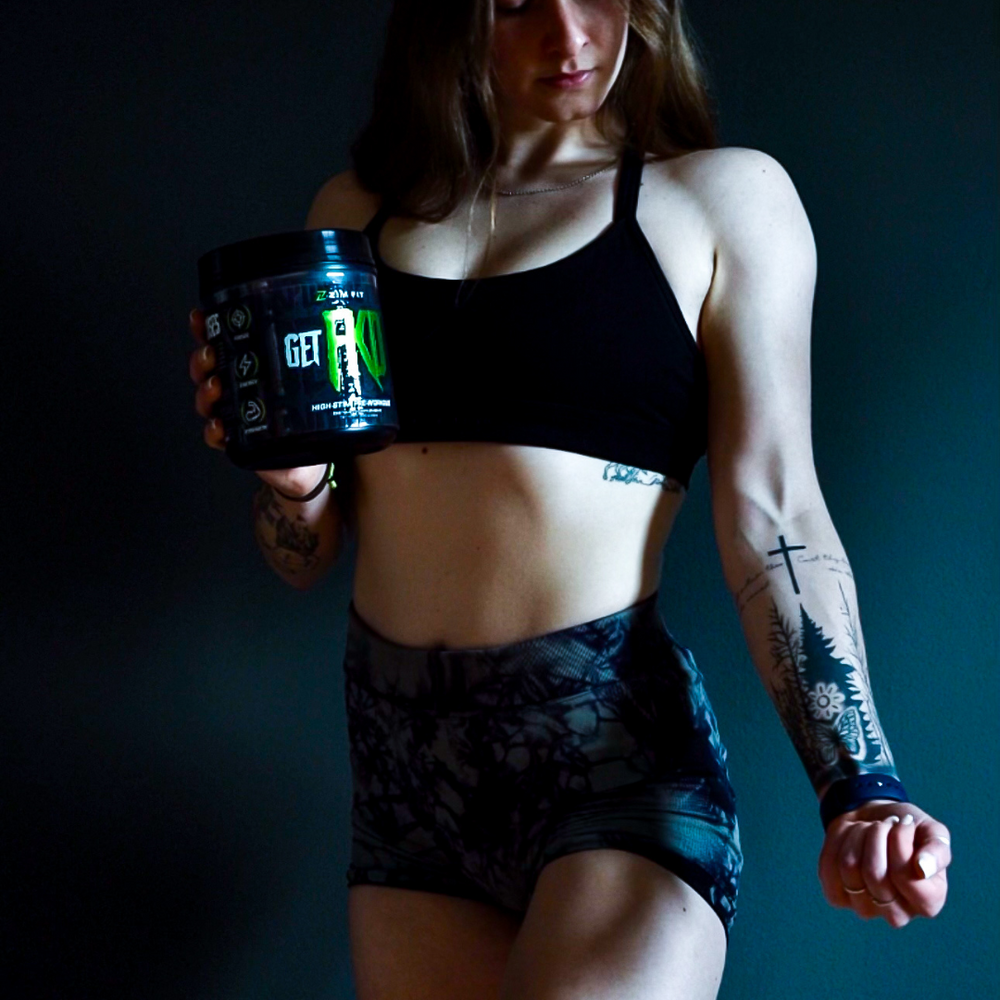
Use GET FKD pre-workout as a worked example, not a description of every tub. It has 30 full servings, with each active ingredient amount disclosed.

Citrulline
A full scoop contains 6g L-citrulline. Citrulline participates in the arginine and nitric oxide pathway, but ingredient-form arithmetic isn't proof of a particular pump or performance result.
Pure L-citrulline and citrulline malate aren't interchangeable weights. If a product specifies a 2:1 citrulline-to-malate ratio by weight, 6g of that mixture contains about 4g citrulline. A 6-8g mixture would supply roughly 4-5.3g. If no ratio is given, don't guess. A critical review of citrulline malate describes mixed exercise results and problems with stated ratios. Don't apply a blend's studied range to pure citrulline without checking the form.
Beta-alanine and betaine
GET FKD contains 4g beta-alanine and 2.5g betaine anhydrous per full scoop. They aren't caffeine, and they don't do the same job.
The ISSN beta-alanine position stand describes 4-6g daily for at least 2-4 weeks, with benefits most apparent in certain high-intensity efforts. GET FKD's 4g sits at the lower end of that range. Daily intake over time matters; the tingle after one serving isn't proof that endurance improved. Betaine is a separate ingredient to compare on the label, not an explanation for that tingle.
Caffeine and focus ingredients
GET FKD has 350mg caffeine per full serving*, alongside 300mg L-theanine, 1.5g L-tyrosine, 400mg Alpha GPC 50% and 20mg Huperzine A 1%. It also lists 1.5g L-taurine, 50mg AstraGin, vitamins B6 and B12, sodium and potassium.
The percentages matter: 400mg Alpha GPC 50% is preparation weight, equivalent to 200mg active Alpha GPC, not 400mg pure active. Huperzine A 1% at 20mg provides 200mcg active. These are label facts, not evidence that the finished formula guarantees sharper focus or prevents caffeine side effects.
*Total caffeine from caffeine anhydrous and Infinergy™ DiCaffeine Malate. The panel lists 300mg caffeine anhydrous and 50mg of the Infinergy ingredient preparation; ingredient weight and active caffeine yield are separate concepts.
What Is in an Energy Drink
Caffeine
The US Celsius 12 fl oz can and C4 Energy 16 fl oz can in our comparison tool each contain 200mg caffeine. That's specific to those entries, not every product bearing either name. Other lines and sizes differ.
Sugar and sweeteners
Both examples list 0g sugar. Celsius uses sucralose; the C4 entry uses sucralose and acesulfame potassium. GET FKD also uses those two sweeteners. This isn't an argument that cans are sugary and powder isn't.
B vitamins, taurine and guarana
These can appear in energy drinks, but vitamins and taurine aren't can-only ingredients. GET FKD lists B6, B12 and taurine too. Guarana can contribute caffeine, so look for the total from all sources.
The Celsius entry shows a 1,810mg MetaPlus blend without individual ingredient amounts. The C4 entry names L-citrulline, beta-alanine, betaine and N-acetyl-L-tyrosine without their individual amounts. Undisclosed doesn't mean absent or ineffective. It means you can't compare the dose. Other cans do disclose amounts; check the actual panel, or look yours up in Flip the Can.
Pre Workout vs. Energy Drink: Side by Side
A useful energy drink vs pre workout comparison keeps portion size visible. Half a scoop halves all the ingredients, not just the caffeine.
| Label check | GET FKD full scoop | GET FKD half scoop | Celsius 12 fl oz | C4 Energy 16 fl oz |
|---|---|---|---|---|
| Total caffeine | 350mg* | About 175mg* | 200mg | 200mg |
| L-citrulline | 6g | 3g | Not listed | Listed; amount undisclosed |
| Beta-alanine | 4g | 2g | Not listed | Listed; amount undisclosed |
| Betaine anhydrous | 2.5g | 1.25g | Not listed | Listed; amount undisclosed |
| Sugar | Not declared on shown panel | Not declared on shown panel | 0g | 0g |
| Sweeteners | Sucralose; acesulfame potassium | Same ingredients, half portion | Sucralose | Sucralose; acesulfame potassium |
| Every active amount printed | Yes | Calculated half of labeled amounts | No; blend total only | No; individual training amounts undisclosed |
| Price per portion | About $2.00 | About $1.00 | $1.97 | $2.72 |
Want your own can in this table? Open Flip the Can, choose CAN, and compare an energy drink to ZIM FIT pre-workout: printed amounts, hidden amounts and price, side by side with a scoop.
Can figures and retail prices are the tool's October 2026 entries, reviewed Nov. 8, 2026. GET FKD is $59.99 for 30 full servings before tax or shipping. Half scoops provide 60 smaller portions, not 60 full-dose servings. Formulas and retail prices change; check your current can.
Is Pre Workout Better Than Energy Drinks? It Depends on the Job
Choose a pre workout if…
You want a measured training formula and control over your starting portion. For GET FKD, start with half a scoop in 6-8 oz cold water, 15-30 minutes before training, to assess tolerance. Once tolerance is assessed, the full-serving directions are one scoop in 10-12 oz cold water at the same timing. A full scoop isn't a goal you have to reach.
Choose an energy drink if…
Convenience is the priority. An energy drink before workout requires no mixing, and a cold can fits an unpredictable day. You can drink less than a whole can, too. Powder's advantage is a measured portion before mixing, not that a can forces you to finish it.
Choose a lower-caffeine option if…
You want less caffeine without simply halving every ingredient. Our low stim pre workout, GET PMPD, has 85mg caffeine, 7g L-citrulline, 3g GlycerPump 65% glycerol powder and 3.2g beta-alanine per full serving. It's its own formula, not half-strength GET FKD. Low-stim still contains caffeine.
Can You Swap Them, or Stack Them?
You can get caffeine from either format. Taking pre-workout without exercising doesn't switch the ingredients off; you can still experience stimulation or beta-alanine tingling, with no workout required. A training formula may bring ingredients you don't need for desk-time alertness.
Don't combine GET FKD and an energy drink as a workout stack. If you've already had a can, GET PMPD's 85mg also adds to the day's total; it doesn't cancel earlier caffeine. Choose one pre-workout for a session, not FKD and PMPD together. Follow the current label and don't exceed one serving in 24 hours.
Timing matters too. A placebo-controlled study in 12 healthy sleepers found that 400mg caffeine disrupted objectively measured sleep even six hours before bed, reducing total sleep time by over an hour. It didn't test GET PMPD or an 85mg dose, and it doesn't establish a universal bedtime cutoff. Speak with a healthcare professional about sensitivity, conditions, medications or other concerns; follow label exclusions, including age and pregnancy or nursing warnings.
How Much Does Each Cost Per Session?
GET FKD is $59.99 for 30 full servings: about $2 a session. The can isn't automatically more expensive.
| Option | Per session | Annual example | Compared with GET FKD |
|---|---|---|---|
| GET FKD full scoop | $2.00 rounded | $520.00 | Reference |
| Celsius 12 fl oz | $1.97 | $512.20 | $7.80 less per year |
| C4 Energy 16 fl oz | $2.72 | $707.20 | $187.20 more per year |
These examples use the tool's October 2026 can prices and a rounded $2 scoop, excluding tax and shipping. They're consumed-serving comparisons, not the cash needed to buy whole tubs or cases. Your store, multipack or promotion may change the result.
Celsius is slightly cheaper in this example. C4 costs more. GET FKD's case is a disclosed training formula at about $2 per full serving, not a claim that every can loses on price.
Run your own can and weekly sessions through Flip the Can to Compare Your Energy Drink to GET FKD, or Shop GET FKD to read the formula and directions.
Pre Workout vs. Energy Drinks FAQs
Which is better before a workout, pre-workout or an energy drink?
A pre-workout with disclosed training ingredients can be the more useful choice for a session. A can wins on preparation time. Match the ingredients and caffeine to your needs rather than assuming the container determines performance.
Is pre-workout basically just an energy drink?
Not necessarily. Both may contain caffeine, but a pre-workout can also provide measured amounts of ingredients such as citrulline and beta-alanine. Some cans include training ingredients too; compare their amounts.
Can I use pre-workout as an energy drink?
It can supply caffeine, but you may not need the other training ingredients for everyday alertness. Side effects can still occur without exercise. Follow the label rather than sipping it as an all-day drink.
Can I use an energy drink as a pre-workout?
Yes, a caffeinated energy drink can provide caffeine before exercise. That doesn't make its ingredient profile equivalent to a disclosed training formula. Check the can's amounts, directions and warnings.
Is it OK to mix pre-workout and an energy drink?
Don't combine GET FKD and an energy drink as a workout stack. A full serving plus a 200mg can totals 550mg caffeine, above the FDA's cited 400mg daily reference for most adults. Individual limits may be lower.
Is it OK to take pre-workout every day?
Frequency doesn't replace the label's limits. GET FKD directions say not to exceed one serving in 24 hours; count caffeine from every source and follow all warnings. That limit isn't a personal safety guarantee.
How much caffeine is in pre-workout vs. an energy drink?
GET FKD has 350mg per full serving, about 175mg per half scoop; GET PMPD has 85mg. The US Celsius 12 fl oz and C4 Energy 16 fl oz entries compared here each have 200mg. Other formulas and sizes differ.
Is pre-workout cheaper than energy drinks?
Not every time. GET FKD is about $2 per full serving. The tool's October 2026 prices put Celsius at $1.97 and C4 Energy at $2.72, so some cans cost about the same or less.
When should I take pre-workout vs. an energy drink?
GET FKD directions specify 15-30 minutes before training, starting with half a scoop to assess tolerance. Follow your energy drink's own directions. Consider bedtime and earlier caffeine, not just your workout start time.
Is pre-workout or an energy drink better if I train at night?
Choose by caffeine and timing, not powder versus can. GET PMPD offers 85mg per full serving, but lower caffeine doesn't promise unaffected sleep. If avoiding stimulants is the requirement, choose a genuinely stimulant-free option.


Leave a comment